

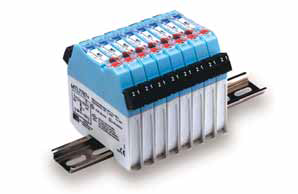
MTL7000 Series award-winning, intrinsic safety shunt-diode safety barriers are innovative devices designed to provide exceptionally high packing densities, straightforward‘single operation’ installation and simplified connection, commissioning and maintenance facilities. Many of the MTL7000 Series features duplicate the functions of conventional field terminals and the barriers can, therefore, ‘double up’ as terminals for many applications, saving even more space. A barrier width of only 7mm enables
maximum packing densities due to the use of surface mount and thick film hybrid circuit technologies (subjects of patent applications). Barrier identification is provided by one or both of two methods. The first consists of tagging strips mounted on posts located at each end of a row of barriers while the other consists of separate
identifiers attached to the tops of individual barriers. Of these, the first can be used to tag locations as well as barriers and is recommended for large installations while the second is better suited to installations of a few barriers only. An optional power comb simplifies installations where multiple barriers are powered from a common 24V dc source (via a power feed module or a dummy barrier). The comb replaces individual power supply connections to each barrier, yet allows single barriers to be removed without affecting the others. The power feed module powers up to 40 barriers and incorporates a trip which switches off the supply to the barriers if a fault (such as an overvoltage) occurs in the power source circuit. Secondary replaceable fuse versions of many barriers are available and form the MTL7100 sub-series. These are useful where there is
a possibility of faults occurring during commissioning which would otherwise blow the barriers' internal safety fuses. One secondary replaceable fuse for each barrier channel is provided and is lower in value than the related safety fuse. Fuses are packaged in small mouldings which can be latched in a 'disconnect' position to break the safe and hazardous areas during commissioning,
maintenance or fault finding, thus avoiding the need for additional disconnect terminals. Where a fuse is less likely to be necessary, the MTL7200 sub-series uses a latchingout link only, to provide the basic loop disconnection of the MTL7100 sub-series.